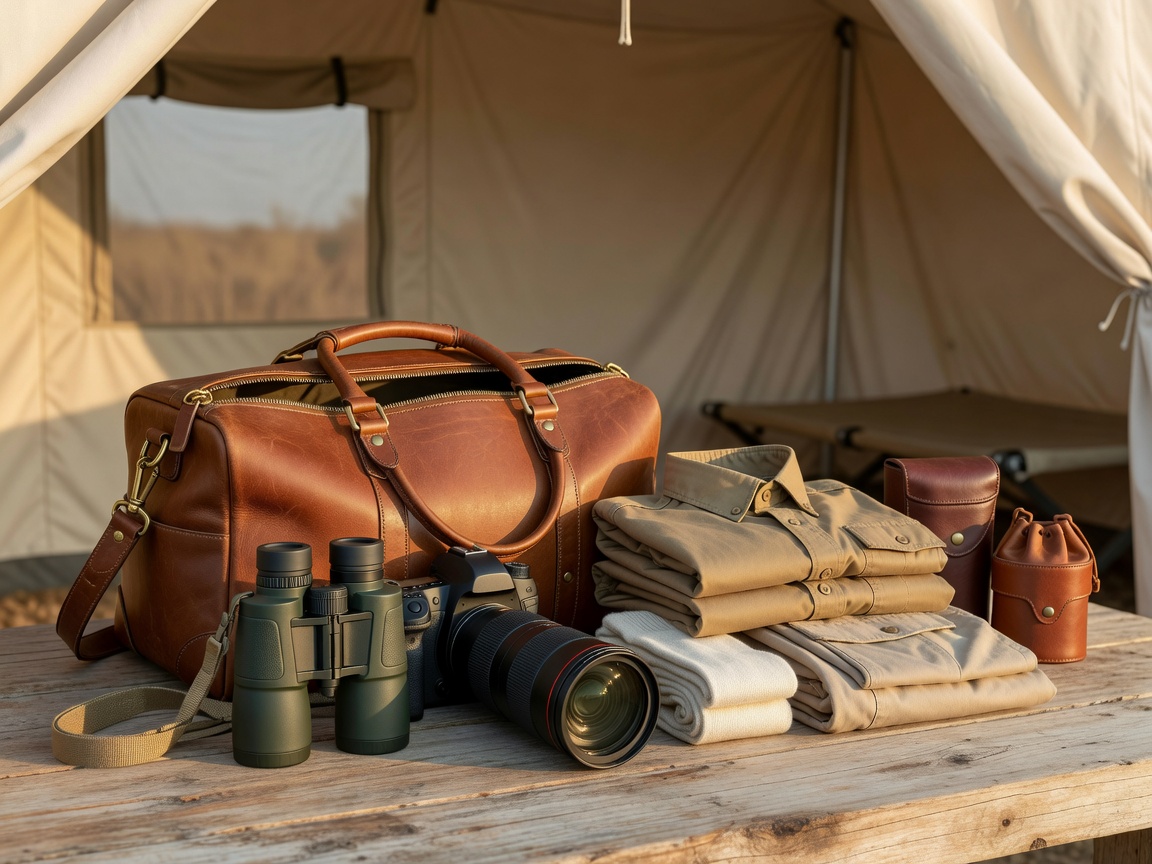
1. Choose the bag first.
For many fly-in safaris, the correct starting point is a soft-sided holdall. Check the allowance supplied for your aircraft sectors and pack to the strictest one. A rigid spinner case may work in a city hotel and fail at a bush airstrip. Use packing cubes or fabric pouches so the bag stays organised without becoming inflexible. Keep medication, documents, one change of clothing, chargers and essential optics in hand luggage where airline and aircraft rules allow. If the itinerary includes laundry, use it. Luxury camps often turn laundry around efficiently, but underwear may be excluded in some places, so pack accordingly.
2. Build clothing in layers.
Safari clothing should be quiet, comfortable and neutral in colour. Beige, olive, stone, khaki and muted brown are common because they do not shout in the landscape. Avoid bright whites and very dark blues or blacks where tsetse flies may be a concern. Early drives can be cold, open vehicles add wind chill, and midday can be hot. Use layers: breathable shirt, light fleece or jumper, warm outer layer where needed, and a compact waterproof if the route or season calls for it. Walking safaris require closed shoes with grip. Gorilla trekking usually needs long sleeves, long trousers, gloves for vegetation and footwear that handles mud.
3. Give binoculars priority.
Binoculars are not optional decoration. They help you read behaviour, enjoy birds, scan tree lines and watch without asking the vehicle to move closer. A common safari-friendly specification is around 8x or 10x magnification with an objective lens large enough for dawn and dusk use, but the best pair is the one you can hold steady and carry easily. If two people are travelling, bring two pairs. Sharing binoculars on a good sighting is a fast way to miss half of it.
4. Keep camera gear realistic.
A long zoom lens is useful for wildlife, but weight and dust matter. Mirrorless and DSLR systems offer reach and control; bridge cameras and high-end compact systems can be lighter; phones are good for camp, landscape and short video, but limited for distant animals. Bring more memory and batteries than you expect to need, plus a simple cleaning kit. Use a beanbag or vehicle support if the camp allows it. Avoid changing lenses in dust when possible. If photography is the main purpose of the trip, state that during planning so vehicle seating, guide style and camp choice can support it.
5. Pack the unglamorous items.
Include sun protection, lip balm, insect repellent, a small torch or head torch, travel adaptors, charging cables, a power bank where permitted, spare glasses or contact lenses, and any personal medicines. Check plug types by country and lodge information. Camps may have charging points in rooms, vehicles or common areas, but arrangements vary. A lightweight scarf or buff helps with dust. A notebook is useful for names of birds, tracks and places. Keep fragrance subtle; strong scents are unnecessary in close vehicles and small camps.
6. Photograph with restraint.
Turn off intrusive beeps, avoid flash unless clearly permitted, and keep arms and lenses inside the vehicle when instructed. Do not ask guides to bend rules for a lower angle, a closer approach or a blocked escape route. With people, ask before photographing and accept the answer. With rhino and other sensitive species, avoid precise location sharing. The final instruction is the simplest: watch first, shoot second. A luxury safari gives you time. Use some of it with the camera down.